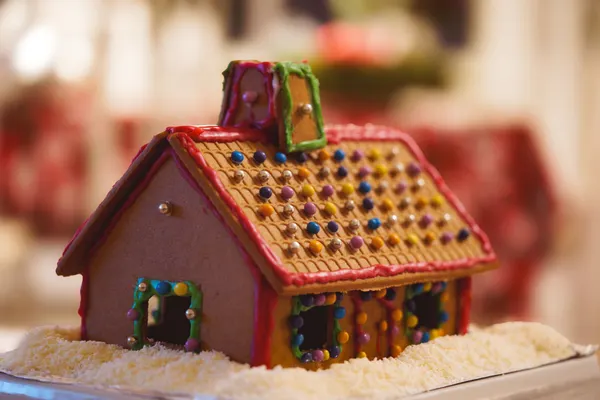
Printable Gingerbread House Template
Pick a size and print the pattern pieces at true size. Every wall and roof panel is labeled with its measurements.
FreeNo signupWorks on your phone
Medium house: 6 pieces on 4 pages
Finished house is about 6 in wide, 6 1/2 in deep and 7 1/2 in tall. Plan on about 2 half-sheet pans of dough rolled 1/4 inch thick (a rough estimate).
| Piece | Cut | Size |
|---|---|---|
| Front wall Door cutout | 1 | 5 1/2 in wide, 4 1/2 in at the sides, 7 1/2 in at the peak |
| Back wall Window cutout | 1 | 5 1/2 in wide, 4 1/2 in at the sides, 7 1/2 in at the peak |
| Side wall 2 windows | 2 | 6 1/2 x 4 1/2 in |
| Roof panel 0.5 in overhang built in | 2 | 7 1/2 x 4 3/4 in |
Print at 100% / actual size, not “fit to page”. Then check the 1 inch square on page 1 with a ruler.
How to use the template
Pick a size, choose whether you want a door, windows and a chimney, and select your paper. The piece list and the page preview update as you tap. Press Print template and set the print dialog to 100% or “actual size”, not “fit to page”. Before you cut anything, measure the 1 inch square on page 1 with a ruler. If it is off, the whole house will be off by the same amount.
Cut the pieces out of the paper, or trace them onto card stock if you want a pattern that lasts for years. Lay each one on rolled dough and cut around it with a small sharp knife or a pizza wheel. The pieces print with the measurements on them, so you can also skip the printer and draw the shapes on parchment with a ruler.
Piece sizes for each house
All three sizes use the same layout: two gable walls (front and back) that stand between two side walls, and two roof panels with a small overhang built in. The gable walls are narrower than the house by the thickness of two side walls, so the corners close up when you build it.
| Size | Front and back walls (cut 1 each) | Side walls (cut 2) | Roof panels (cut 2) | Dough |
|---|---|---|---|---|
| Small | 3 1/2 in wide, 3 in at the sides, 5 in at the peak | 5 x 3 in | 5 3/4 x 3 1/4 in | About 1 half-sheet pan |
| Medium | 5 1/2 in wide, 4 1/2 in at the sides, 7 1/2 in at the peak | 6 1/2 x 4 1/2 in | 7 1/2 x 4 3/4 in | About 2 half-sheet pans |
| Large | 6 1/2 in wide, 4 7/8 in at the sides, 8 3/8 in at the peak | 8 x 4 7/8 in | 9 x 5 1/2 in | About 2 half-sheet pans |
The small house is about the size of a kit house and fits on a dessert plate. Medium is the classic table-top size. Large makes a centerpiece and needs a board or tray at least 4 inches wider than the house all round, so there is room for a candy yard and snow.
Dough and icing amounts
As a rule of thumb, roll construction gingerbread about 1/4 inch thick. Thinner walls bake crisp but can crack when you stand them up, and thicker walls take longer to bake through. The “half-sheet pans” figure above is a rough estimate based on the area of the pieces, with room for the scraps you lose between them. Reroll scraps once and use them for trees, people or a fence.
For icing, a stiff royal icing holds the walls. Our gingerbread house decorating ideas post has the Wilton recipe we use, which makes about 3 cups. That is usually enough to build a small or medium house and pipe the trim. Make a second batch for a large house or a heavy candy roof.
Bake, trim, then build
- Cut the pieces on parchment so you can slide them onto the pan without stretching them.
- Bake until the edges are firm. Dough spreads a little in the oven, so lay the paper pieces back on the warm gingerbread and trim the edges straight.
- Let every piece cool flat until it is hard, ideally a few hours or overnight.
- Decorate the walls while they are flat. It is much easier than piping on a standing wall.
- Pipe icing along the bottom and side edges and stand one side wall and the front wall together. Hold them with cans or jars.
- Add the other two walls, then let the box set for at least an hour before the roof goes on.
- Pipe along the top edges and press the roof panels on. Hold them for a minute, then leave them to set before you add heavy candy.
Set times vary with humidity, so give it longer if the icing still feels soft. Use battery lights inside the house rather than a real candle, and keep finished houses away from candle flames on the table.
Decorating ideas
Once the shell is built, see 21 gingerbread house ideas for roofs, windows and candy yards. A finished house also makes a good centerpiece: there are a few ways to style it in our Christmas table decor ideas, and a small house works on a mantel too (see Christmas mantel ideas). For everything else for the season, browse all our Christmas decor ideas.
Frequently asked questions
How do I print the gingerbread house template at the right size?
Open the print dialog and set the scale to 100% or actual size, not fit to page. Then measure the 1 inch test square on page 1 with a ruler. If it measures 1 inch, every piece is true to size. If it does not, check that your printer is not shrinking the page.
How thick should gingerbread be for a house?
A common rule of thumb is about 1/4 inch for walls and roof panels. Thinner dough bakes crisp but can crack or bow when the house stands up. Thicker dough is sturdier but takes longer to bake through. Roll it on parchment so the pieces keep their shape when you move them.
Why don't my gingerbread walls fit together?
Dough spreads a little while it bakes, so baked pieces often come out slightly bigger than the pattern. Lay the paper piece back on the warm gingerbread right after baking and trim the edges straight with a sharp knife. Straight, trimmed edges are what make tight corners.
How long should the walls set before adding the roof?
Let the four walls set for at least an hour before the roof goes on, and longer on a humid day. Prop them with cans or jars while the icing hardens. Add the roof, hold it for a minute, then leave the house to set again before you press on heavy candy.
Can I make the template smaller or bigger?
Yes. Choose Custom and enter the width, depth, wall height and roof peak in inches. The tool keeps every size within limits that fit on one sheet of US Letter or A4 paper, recalculates the roof panels from the roof slope, and lays the pieces out on as few pages as it can.
More free planning tools: all decorating tools.