Lunar New Year Decorations: 20 Ideas for 2027, Year of the Goat

Jump to an idea (20)
- Before you start
- 1. String red lanterns across a porch or patio
- 2. Dress the front door as a full set
- 3. Hang spring couplets in the right order
- 4. Put a fu character on the door
- 5. Hang a Chinese knot inside the entry
- 6. Stick a paper cutting on the window
- 7. Pair paper cuttings on glass doors
- 8. Cut a paper goat for 2027
- 9. Cluster red lanterns in a dark corner
- 10. Hang small ornaments on blossom branches
- 11. Set a single plum blossom vase on a side table
- 12. Place two matching vases as a pair
- 13. Fill a bowl with mandarin oranges
- 14. Add a potted citrus or kumquat tree
- 15. Set up a tea table for visitors
- 16. Keep red envelopes by the door
- 17. Build a fruit and gold coin platter
- 18. Make paper lanterns with kids
- 19. Display one goat figure for the new year
- 20. Save some lanterns for the Lantern Festival
- Final tips
Lunar New Year 2027 starts on Saturday, February 6, and it opens the Year of the Goat. The eve and its big family dinner fall on Friday, February 5, and the Lantern Festival closes the season on Saturday, February 20. These 20 ideas cover the door, the windows, the table and a few kid projects, with counts, sizes and costs for each.
The list leans on Chinese customs because that is where red lanterns, couplets and paper cuttings come from. Vietnamese Tết and Korean Seollal have their own traditions, and a few appear below. Family practice varies a lot, so if your relatives do something differently, follow them. For more holidays from around the world, browse our world holidays decor ideas.
Before you start
Clean first. Many families clean the house thoroughly before New Year's Eve, then skip sweeping and taking out trash on New Year's Day so good luck is not swept away. Hang most decorations after the cleaning, usually February 4 or 5, 2027.
Red and gold are the main colors. White is linked with funerals in Chinese tradition, so many people keep it out of New Year decor. Check your lease or HOA rules before you tape anything to a door.
1. String red lanterns across a porch or patio
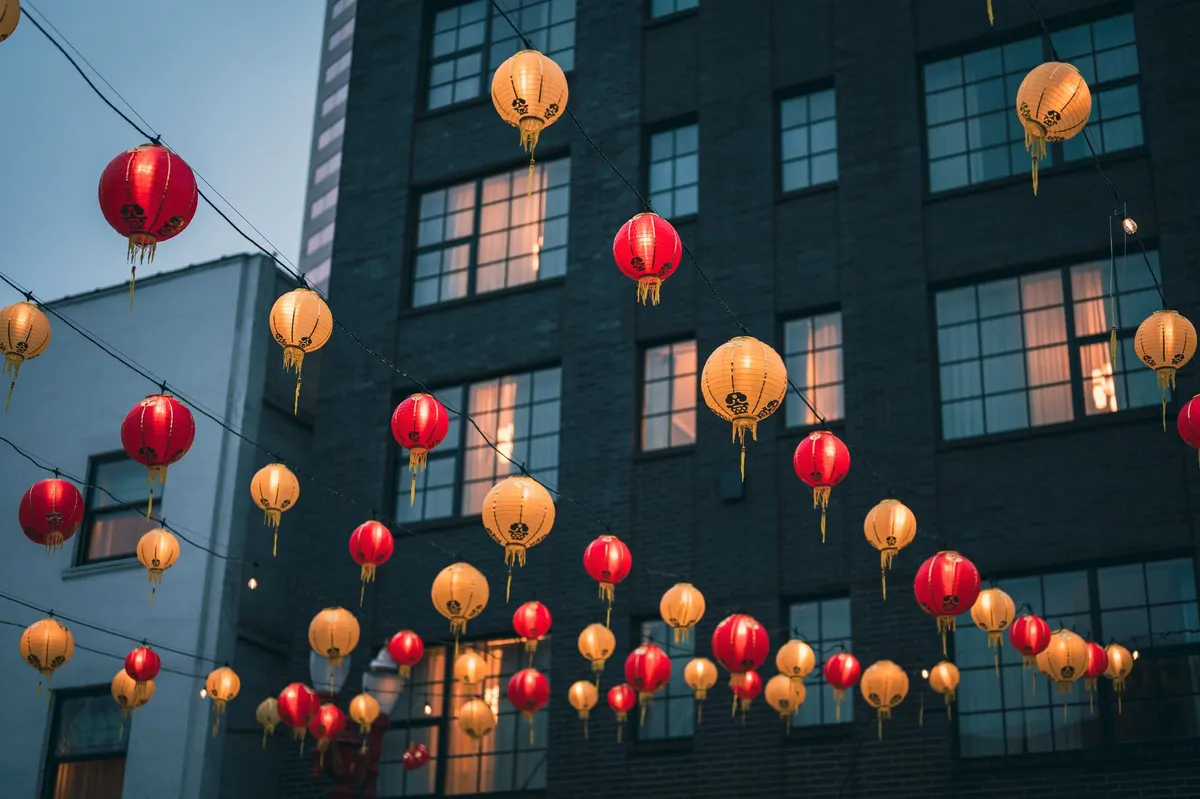
Run a length of outdoor cable or sturdy cord between two anchor points, such as porch posts or a fence and a gutter hook, then clip on 6 to 10 lanterns spaced about 18 inches apart. Mixing pale orange with deep red, as in this street display, keeps the row from looking flat. Nylon or fabric lanterns survive rain better than paper. If you want them to glow, thread an outdoor-rated LED string through them and plug it into a GFCI outlet. A pack of ten 10-inch paper lanterns often costs $15 to $25.
2. Dress the front door as a full set
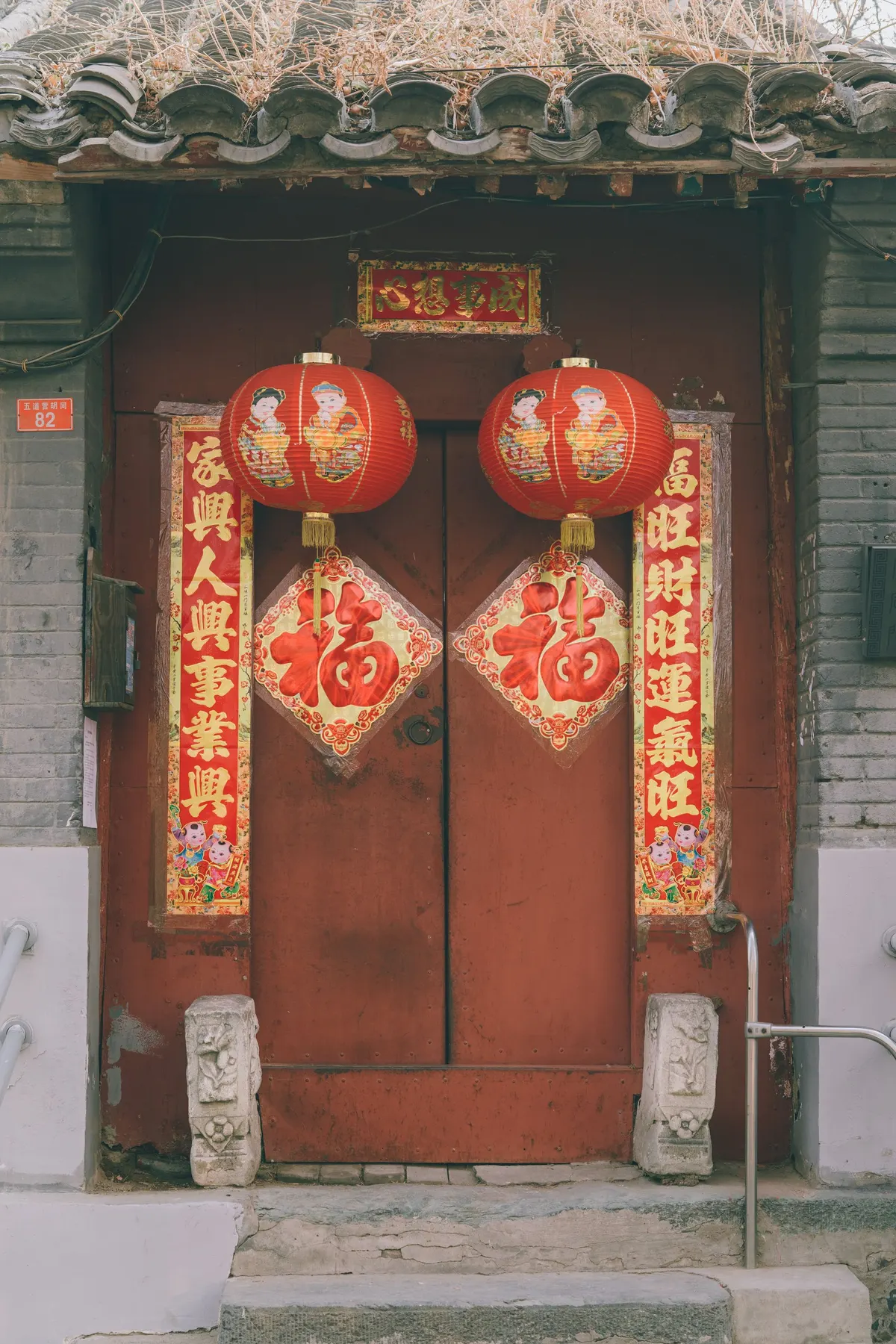
This weathered door shows two red lanterns, one over each door leaf, a pair of tall red couplet banners down the frame, a small plaque above, and a diamond-shaped fu paper on each leaf. Copy the layout on any front door: two lanterns hung just above head height on removable hooks, the couplets running down the left and right edges of the frame, and one fu sign per door. A printed couplet set with a fu sign usually costs $8 to $15 at an Asian grocery store. If you share a hallway, a single fu sign and a small lantern is plenty.
3. Hang spring couplets in the right order
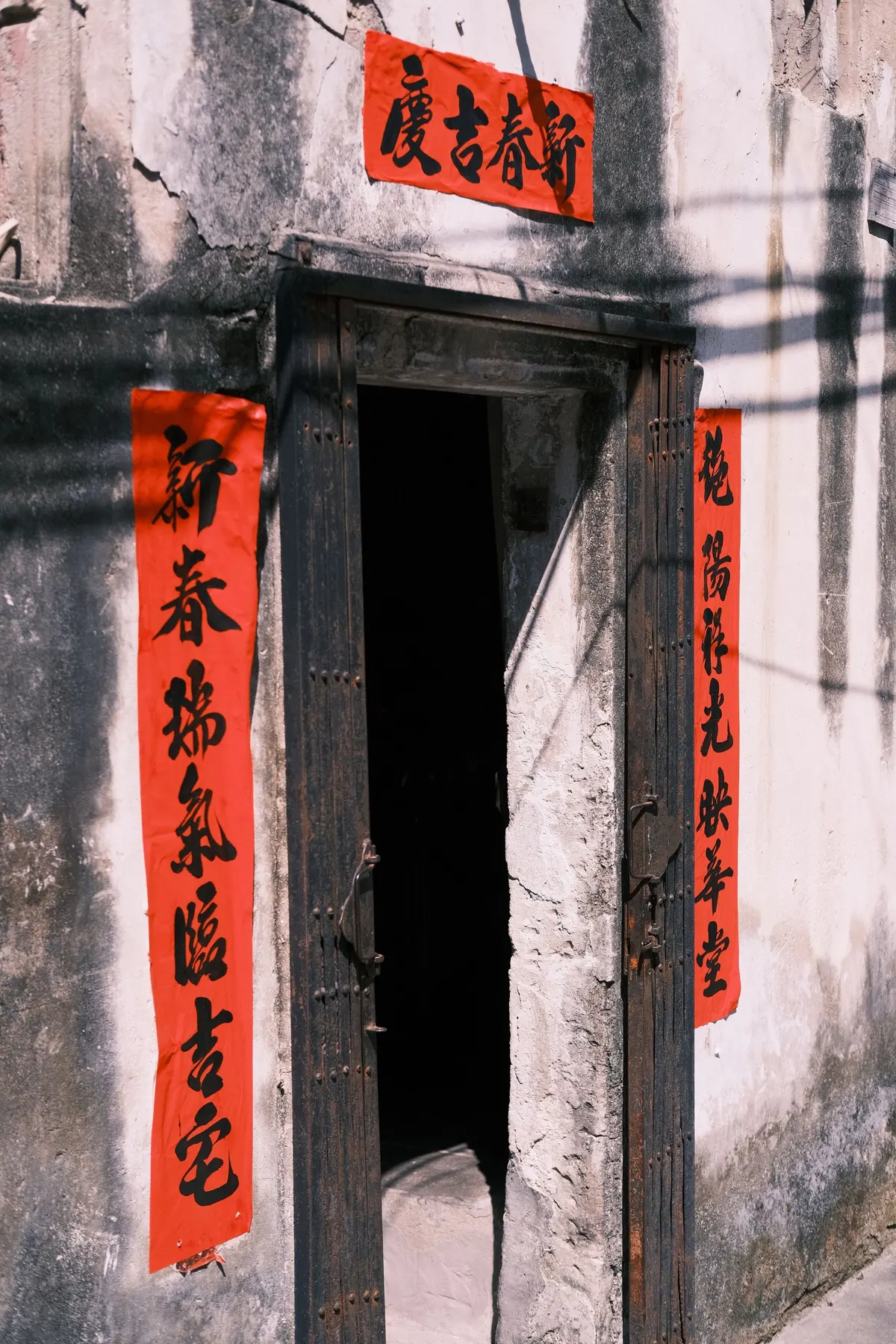
Spring couplets (chunlian) are two vertical lines of verse plus a short horizontal phrase, usually four characters, that goes above the door. This dark doorway in a weathered white wall shows the full set: one horizontal banner over the frame and one vertical strip down each side. Traditionally, facing the door from outside, the first line goes on the right and the second on the left, because the text was read right to left. If your horizontal scroll reads left to right, many guides say to swap the sides. To write your own, cut red paper into strips about 5 by 36 inches and practice with a brush and black ink on scrap first.
4. Put a fu character on the door
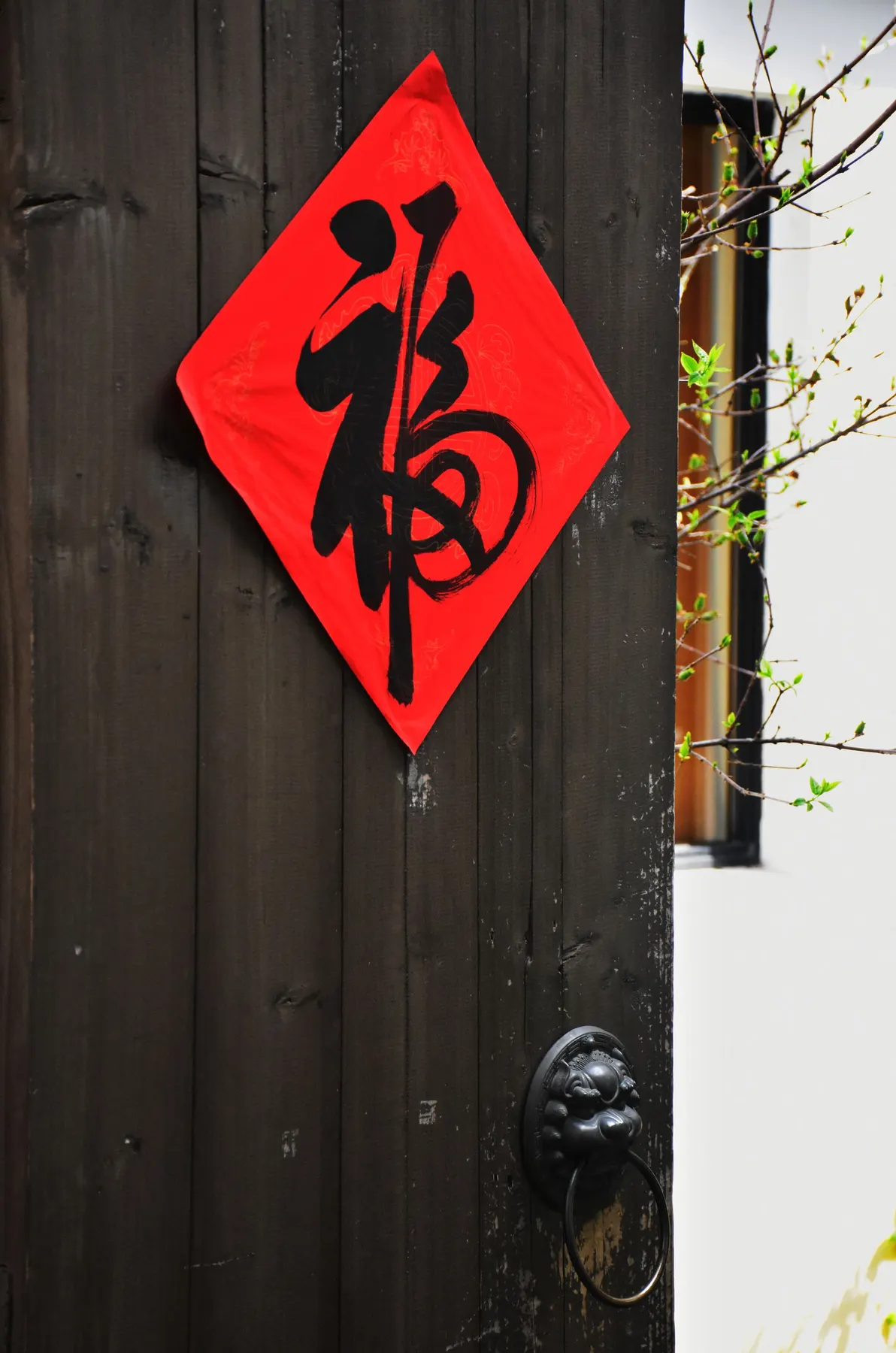
Fu (福) means good fortune or blessing, and it is one of the most common New Year signs. Here a single red diamond with a black brushed fu sits on a dark wooden door above a lion-head ring knocker. A 10 to 12 inch diamond reads well from the sidewalk. You will often see fu hung upside down, because "upside down" (dao) sounds like "arrive" in Mandarin, so the sign says fortune has arrived. Customs differ: some families keep the main door sign upright and turn the fu upside down only on cabinets, rice bins or inner doors. Use poster putty so it peels off cleanly.
5. Hang a Chinese knot inside the entry
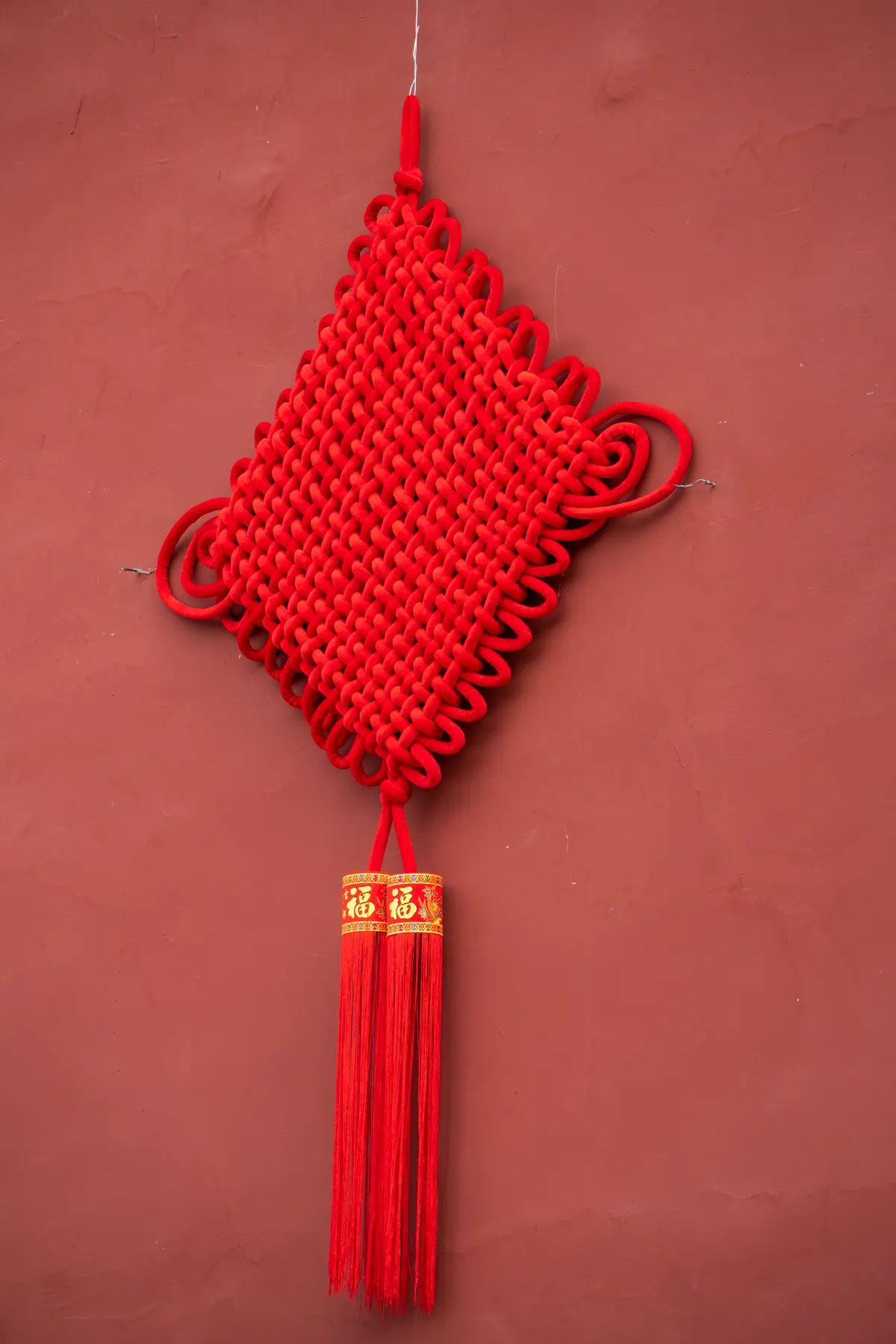
A Chinese knot is a woven cord ornament. This one is a large diamond knot with two long red tassels against a red wall. Hang one inside the front door, on a coat hook, or from a cabinet knob where guests see it as they come in. A 20 to 30 inch knot works on a door; smaller 6-inch knots fit drawer pulls and car mirrors. They cost $3 to $12 and pack flat. A removable hook rated for 1 pound holds even the big ones.
6. Stick a paper cutting on the window
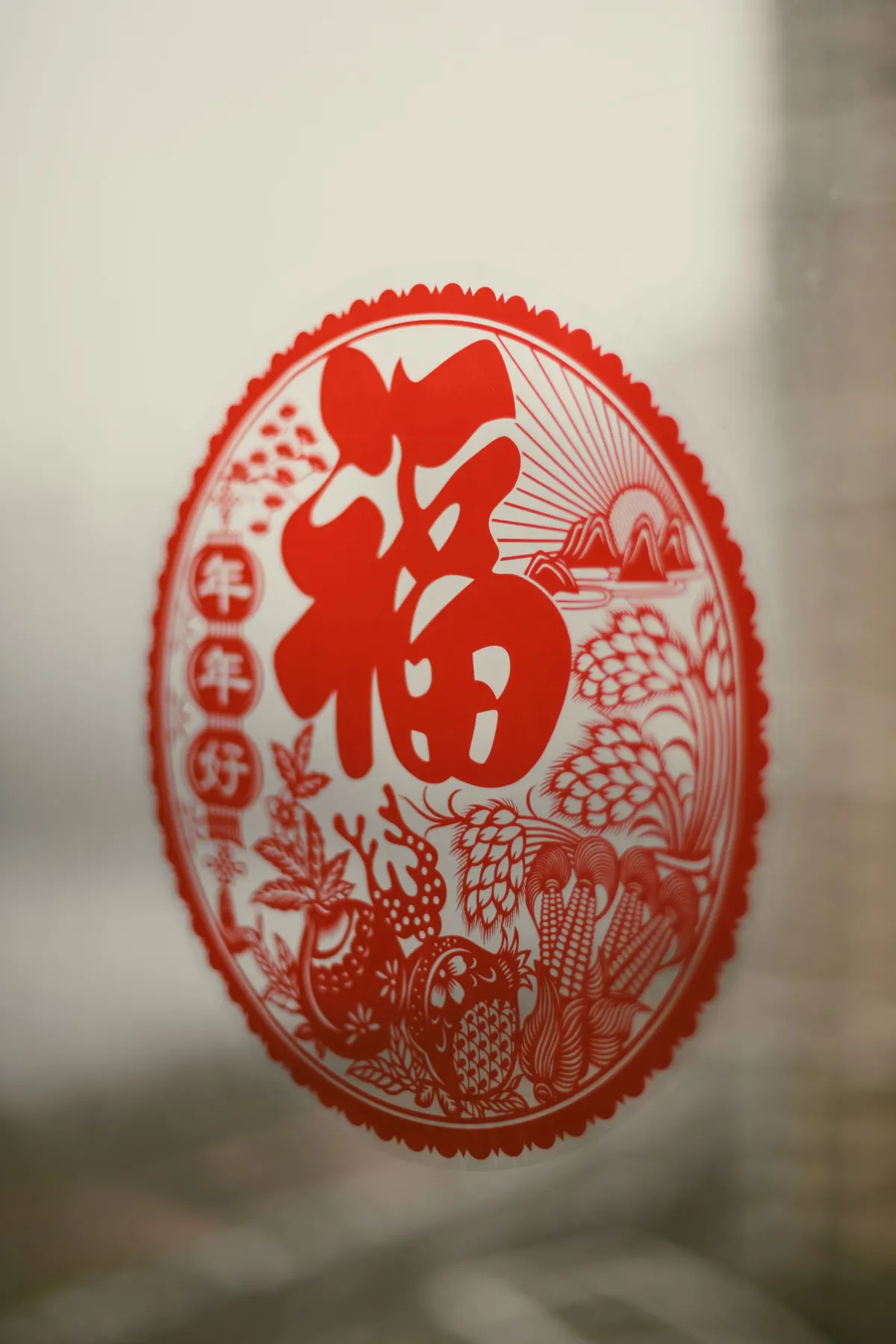
Window flowers (chuanghua) are red paper cuttings made for the glass, a custom that is especially strong in northern China. This oval cutting has a large fu at the center, with a rooster, corn, wheat and a sun over mountains around it. One 8 to 12 inch cutting per window pane is enough. Stick it to the inside of the glass with a small dab of clear glue stick or two loops of clear tape on the back, so it looks clean from the street. Packs of 10 to 20 cost a few dollars. Store flat pieces between sheets of cardboard and many will last a second year.
7. Pair paper cuttings on glass doors
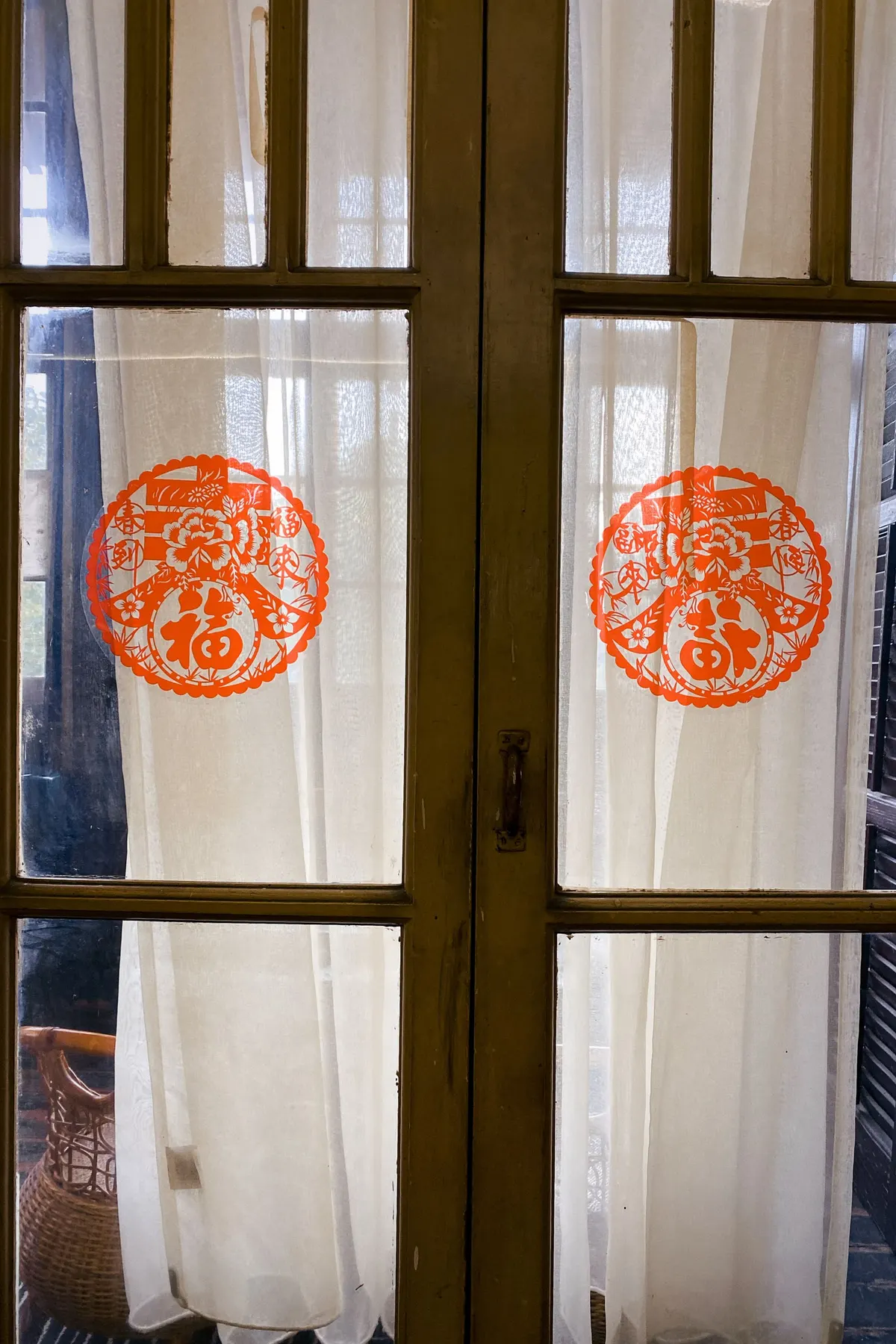
Good things are said to come in pairs. These glass double doors each carry one round orange-red floral paper cutting at the same height, with white curtains behind making the color stand out. Patio doors, French doors and a pair of windows all suit this. Center each cutting at about eye level, roughly 60 inches from the floor, and measure so both sit exactly the same distance from the frame. Many paper cuttings have a mirrored partner, so check that you have a matched set before you tape them up.
8. Cut a paper goat for 2027
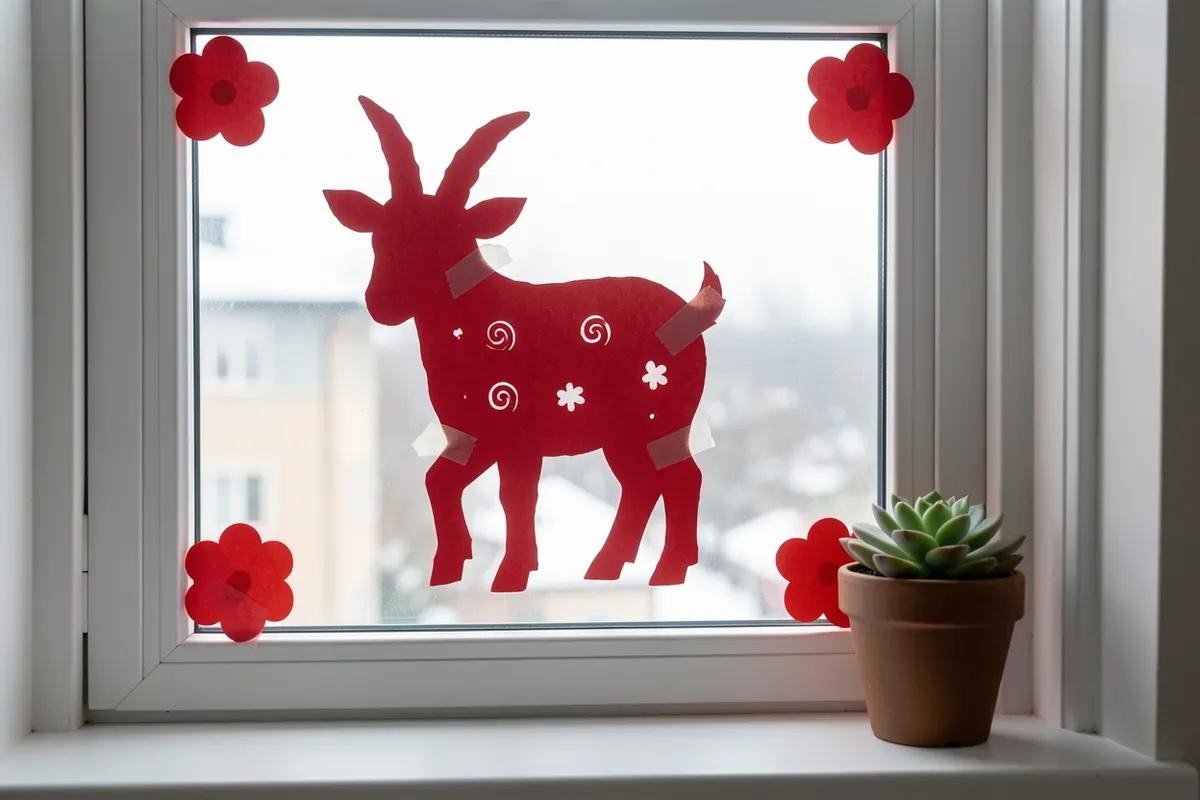
In Chinese, the animal (yang) can mean goat, sheep or ram, so any of the three is correct in English, and Vietnamese tradition calls it the goat. Draw a goat in profile, about 10 inches long, on a 12-inch square of red paper, mark a few swirls or flowers inside the body, and cut it all out. Tape it to the glass with three or four small strips of clear tape on the tail, legs and neck, then add four small round flower cuttings in the corners. Budget about 45 minutes for an adult and a craft knife for the inner shapes.
9. Cluster red lanterns in a dark corner
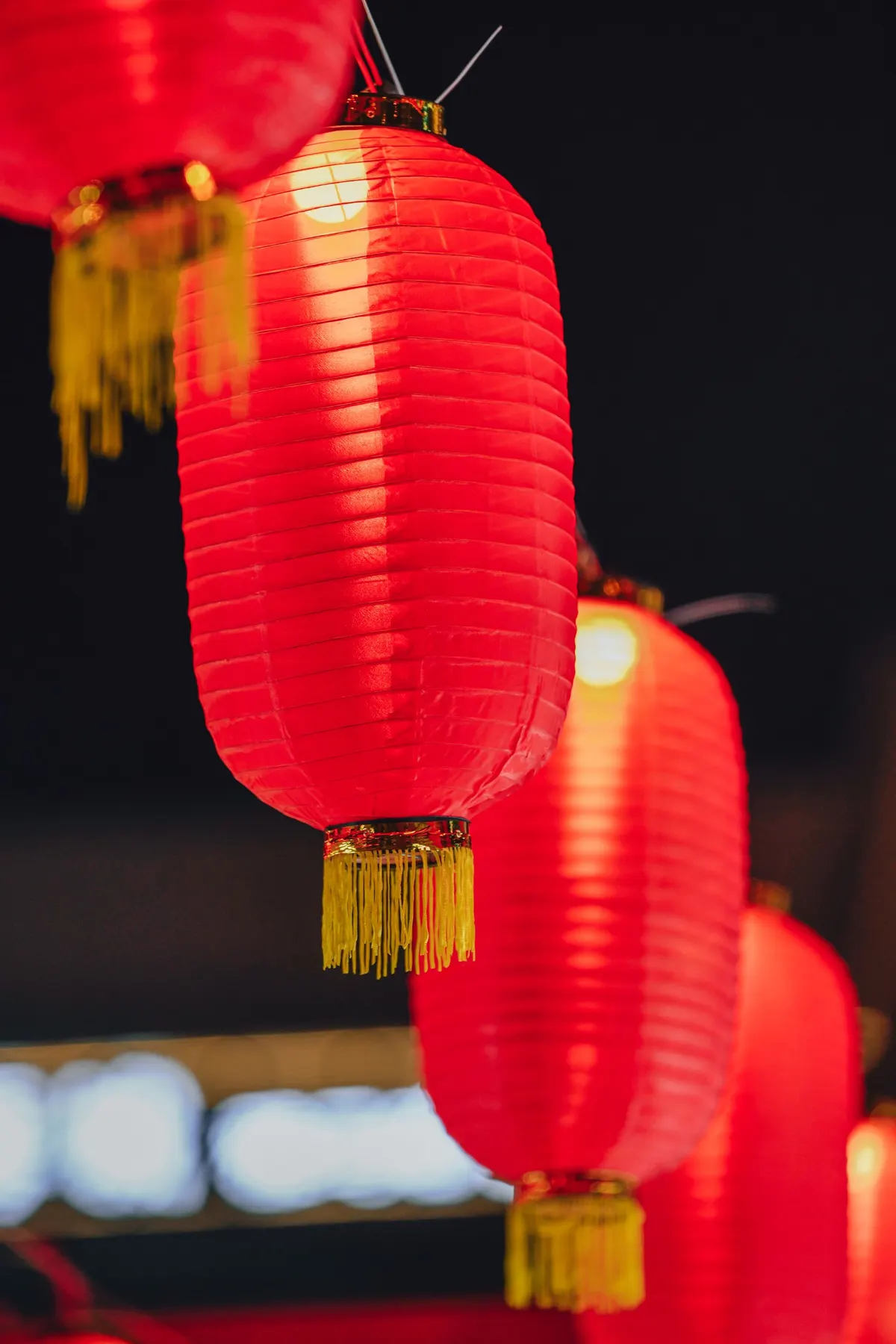
Here several red lanterns with gold caps and yellow tassels hang at different heights, which keeps them from lining up like a fence. Hang 3 to 5 indoor lanterns from a ceiling hook or a curtain rod, staggering the drops by 6 to 10 inches. Odd numbers usually look more natural in a cluster. Battery LED puck lights or fairy-light strands are the only safe light source inside a paper or fabric lantern; skip real candles. One cluster near the door costs under $20. For more festival lighting ideas, see our Diwali decor ideas.
10. Hang small ornaments on blossom branches
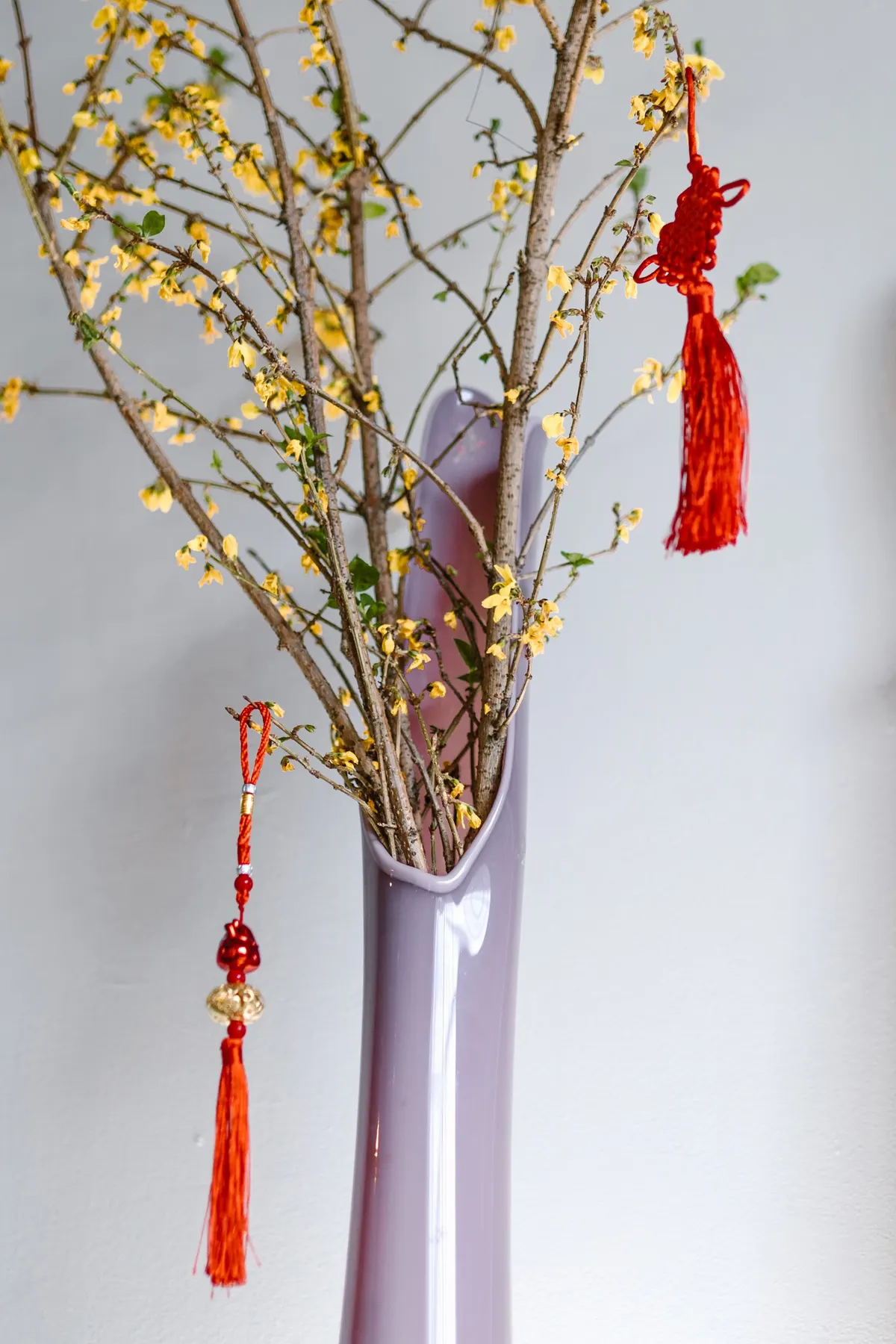
The Lunar New Year is also called the Spring Festival, and flowering branches signal spring. This tall pale purple vase holds branches with small yellow flowers, and two red tasseled ornaments hang from them. Buy 3 to 5 branches of forsythia, quince or plum from a florist or grocery store in late January; they often open indoors in a week or two in warm water. Hang 2 to 6 small red ornaments, such as mini lanterns or knots, on the sturdiest stems. Use a heavy vase at least 12 inches tall, or add a few stones in the bottom so it won't tip.
11. Set a single plum blossom vase on a side table
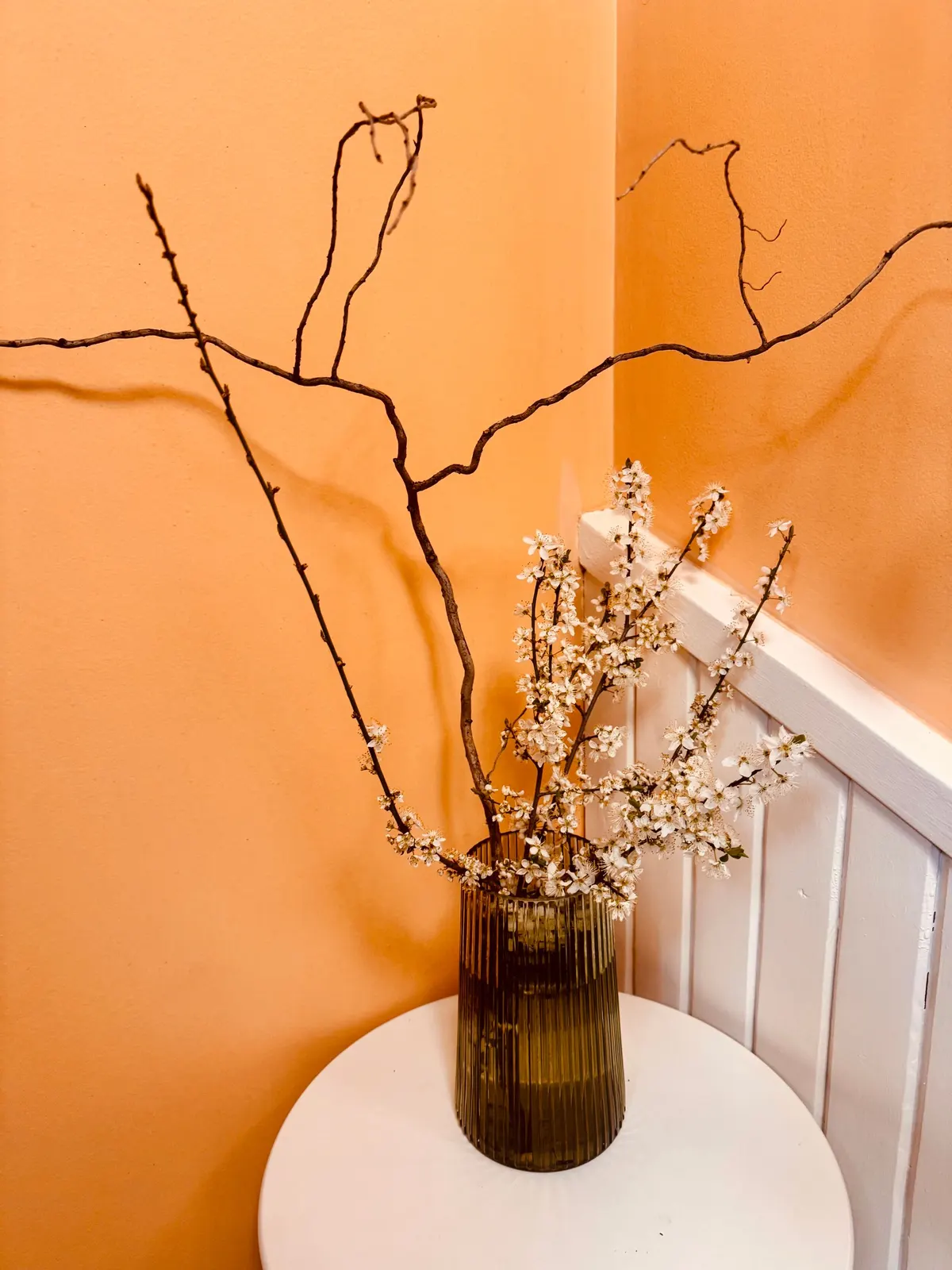
Plum blossoms bloom in late winter, so in Chinese art they stand for strength through the cold. This ribbed olive glass vase holds a few tall bare branches with shorter stems of small white blossoms, on a round white table, and it works because there is nothing else around it. Cut 3 or 4 branches at different lengths, with the tallest about twice the height of the vase. Recut the stems at an angle and change the water every two days. Faux branches cost $8 to $15 each and keep for years if real ones are hard to find where you live.
12. Place two matching vases as a pair
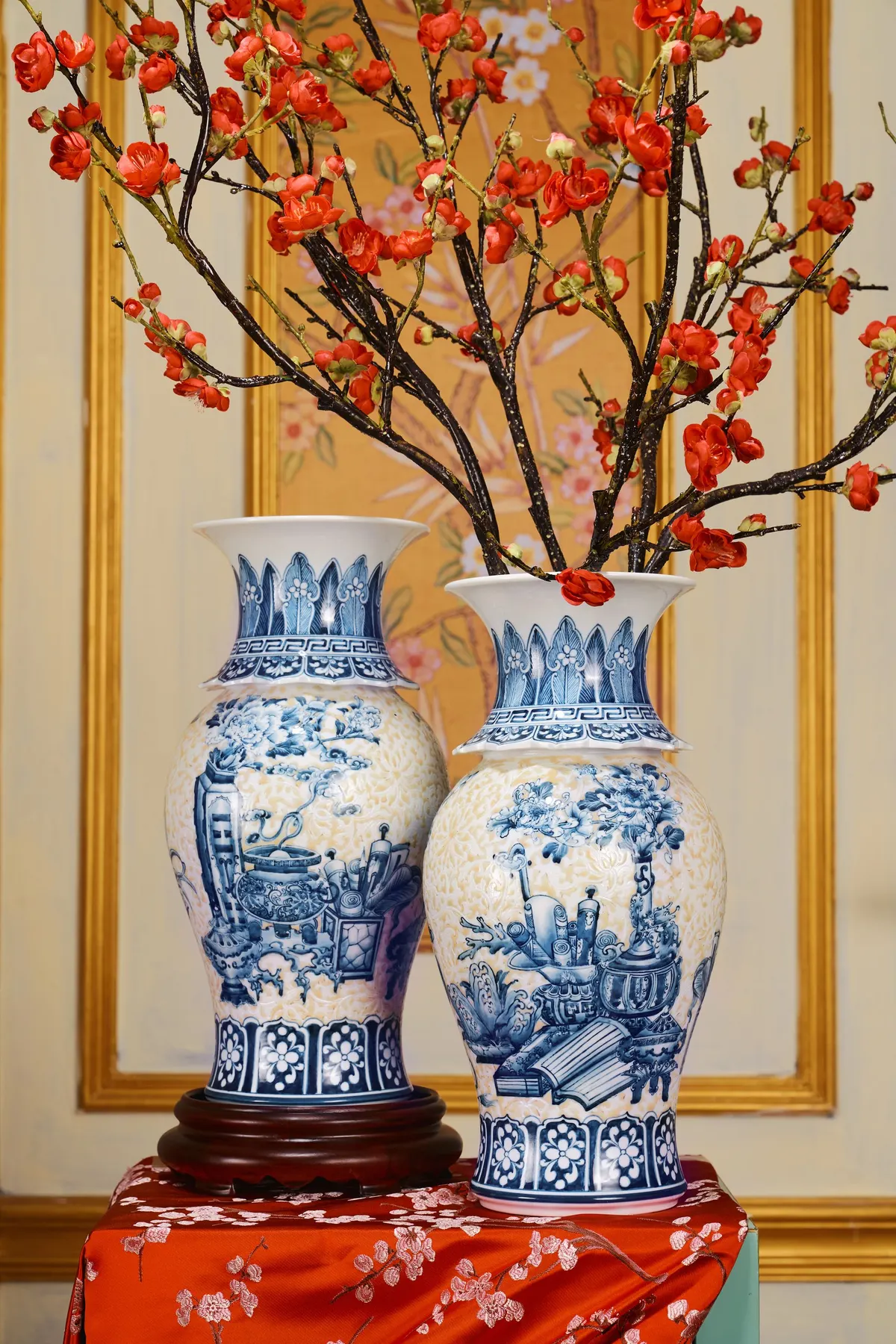
Two of the same thing, side by side, is a classic New Year arrangement. These two blue and white vases share a shape but carry different painted scenes; one sits on a dark wooden stand and the other holds branches of red blossoms, all on red brocade. Use any two matching vases, 8 to 14 inches tall, and fill both with the same stems so they read as a set. A console table or the top of a low bookshelf near the entry works well. Many families avoid groups of four, since the word for four sounds like the word for death in Chinese, so pairs and eights are the safer numbers.
13. Fill a bowl with mandarin oranges
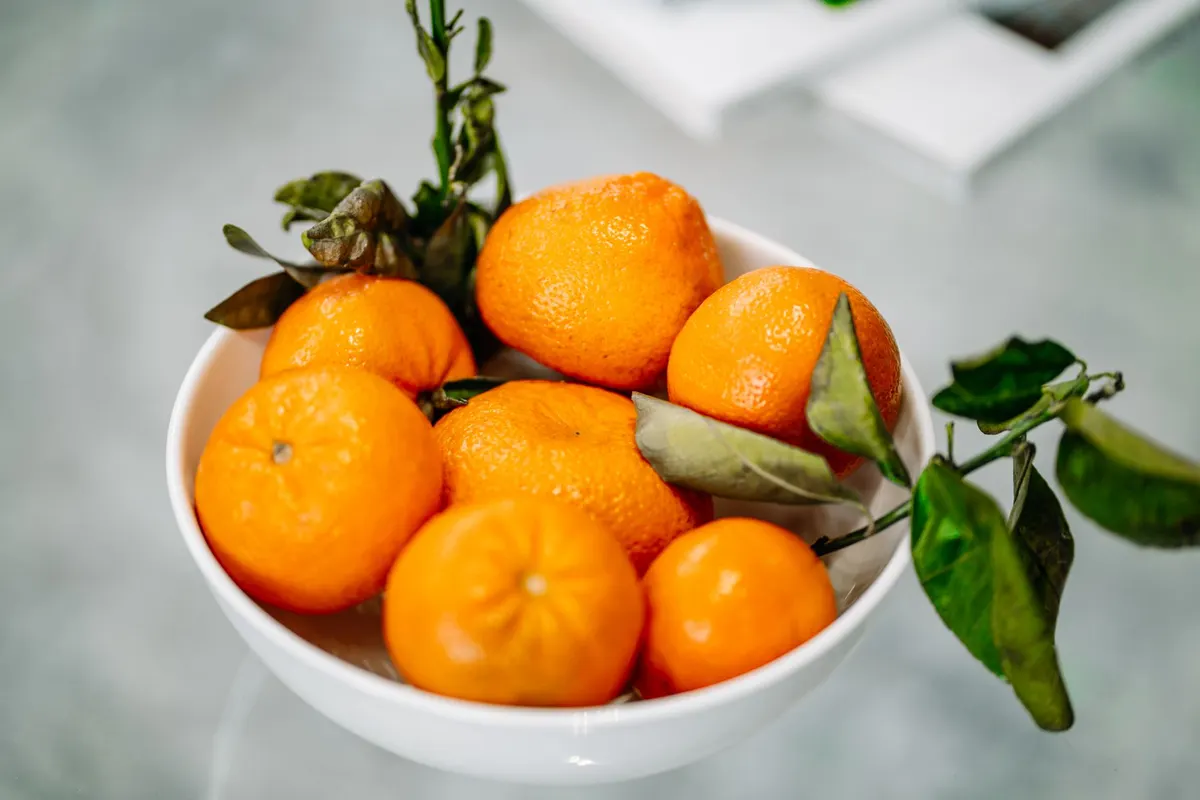
In Cantonese, the word for mandarin sounds like the word for gold, and in Mandarin it sounds close to the word for luck. This white bowl is piled with mandarins, some still carrying their green leaves, which many people consider extra lucky. Buy them with leaves and stems if you can find them; Asian grocery stores usually stock them in the weeks before the holiday. A 5-pound box runs about $8 to $12 and fills two bowls.
14. Add a potted citrus or kumquat tree
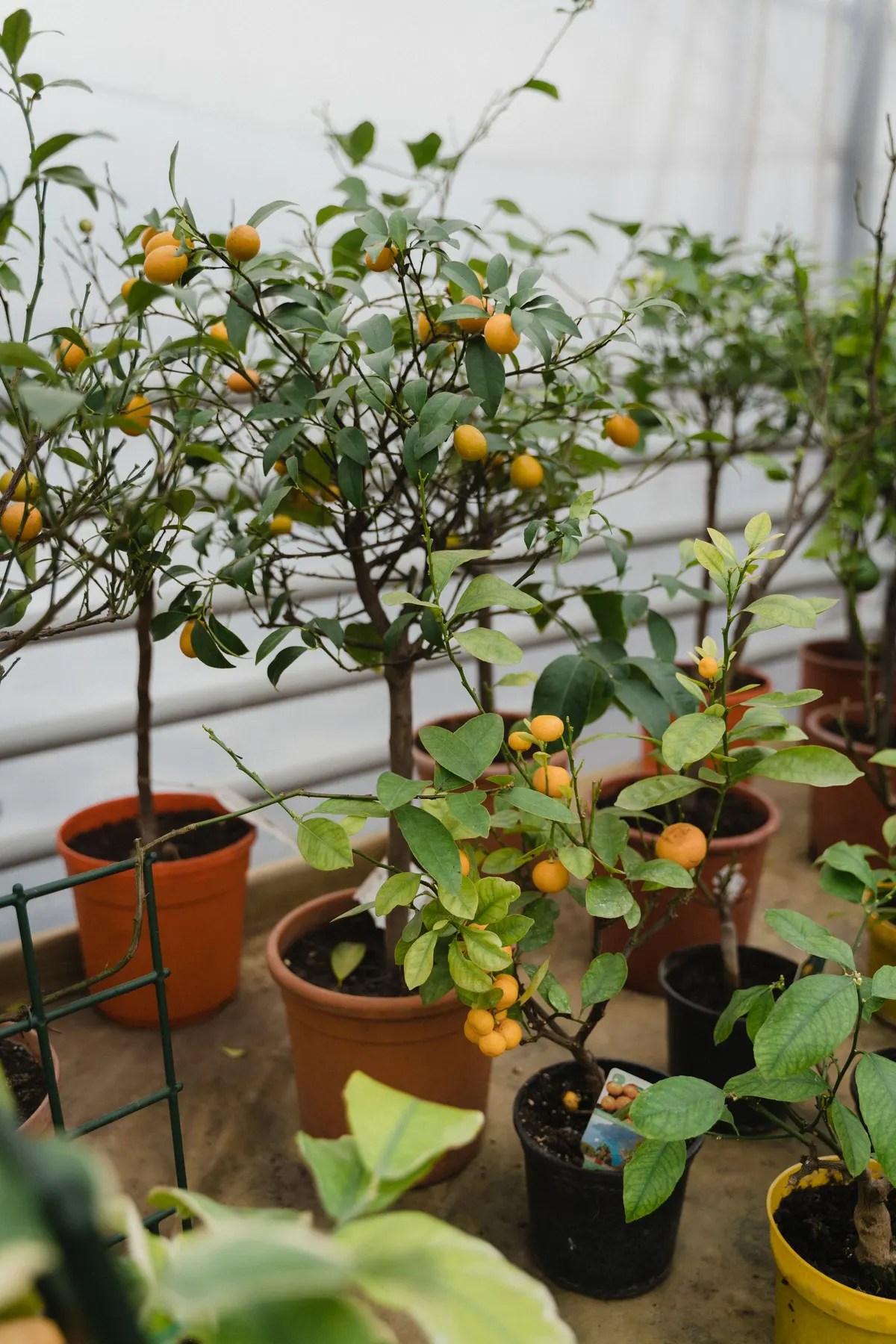
Fruit-heavy citrus trees are a big part of the holiday in Vietnam, Hong Kong and southern China, where kumquat trees stand for plenty and good luck. This row of potted citrus trees is loaded with yellow-orange fruit in orange, black and yellow pots. Set one 2 to 3 foot tree on each side of the front door, or one indoors by a sunny window. Garden centers often sell kumquat and calamondin in winter for $25 to $60. Water when the top inch of soil is dry and keep the pot away from heating vents. Keep the fruit out of reach of dogs, since citrus can upset their stomachs.
15. Set up a tea table for visitors
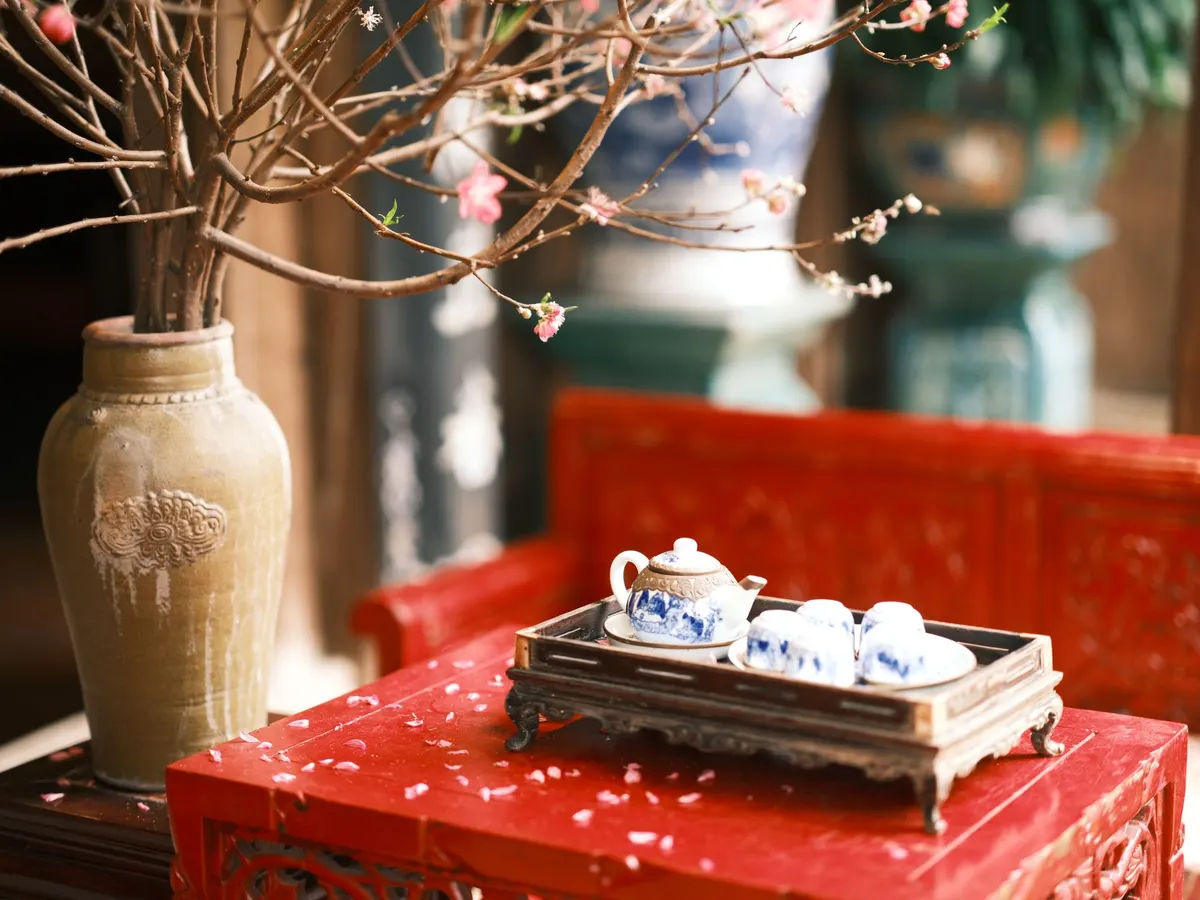
Visiting relatives and friends during the first days of the New Year is common, and a ready tea table makes drop-ins easy. This setup has a blue and white teapot and four small cups on a dark tray on a red table, with a tall vase of pink blossoms beside it. Put the tray on a side table or kitchen island with a kettle nearby, a tin of tea and a small bowl for candy or dried fruit. A plain teapot and six cups from a thrift store often costs under $20, and any red cloth underneath does the rest.
16. Keep red envelopes by the door
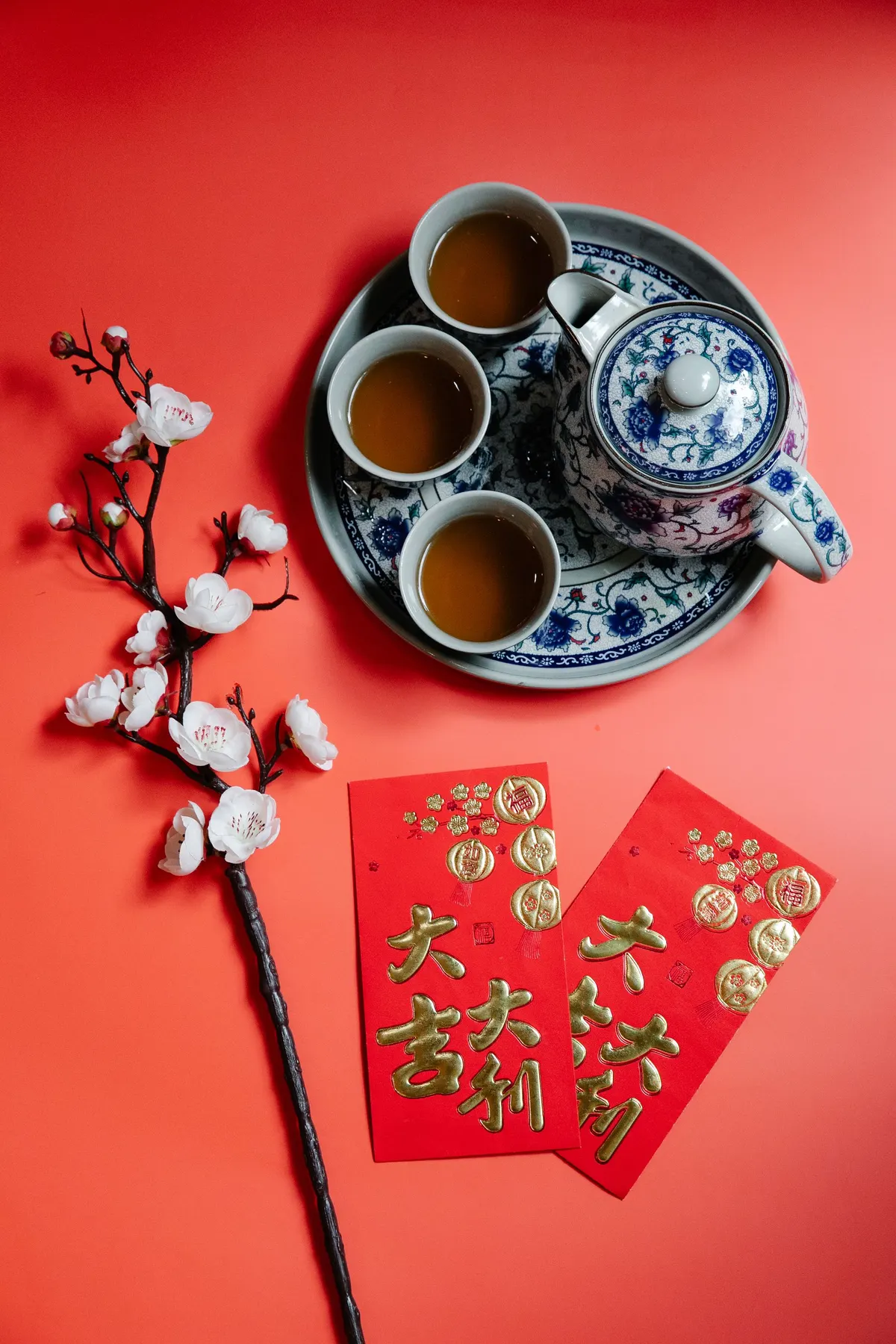
Red envelopes, called hongbao in Mandarin and lì xì in Vietnamese, hold money given to children and unmarried relatives. Here two red and gold envelopes sit beside a blue and white teapot, three cups and a flowering branch on a red surface. Fill envelopes ahead of time with new, crisp bills, and many families avoid amounts with a four. Stack 10 to 20 on a small dish by the entry so you are never caught empty-handed. A pack of 50 costs about $5 to $8. At Korean Seollal, the gift money is called sebaetdon, and the envelopes are not always red.
17. Build a fruit and gold coin platter
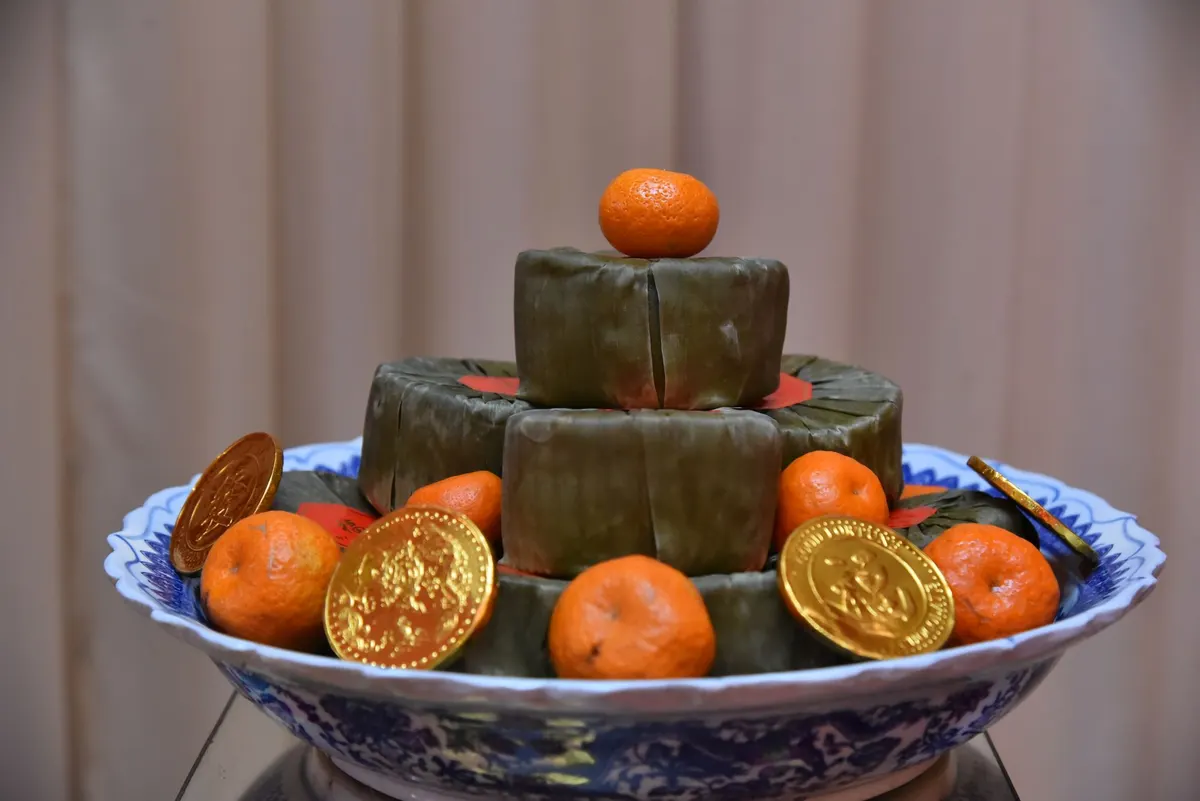
This blue and white bowl-shaped platter holds a stack of leaf-wrapped parcels, six mandarins and four gold coin decorations. Start with a 12 to 14 inch platter, put the tallest item in the middle, and ring it with fruit. Rice cakes (nian gao), sweets or a pomelo all fit, and pomelo is linked with plenty. Keep the platter under about 8 inches tall so people can talk across the table. For more table layouts, see our table decorating ideas.
18. Make paper lanterns with kids
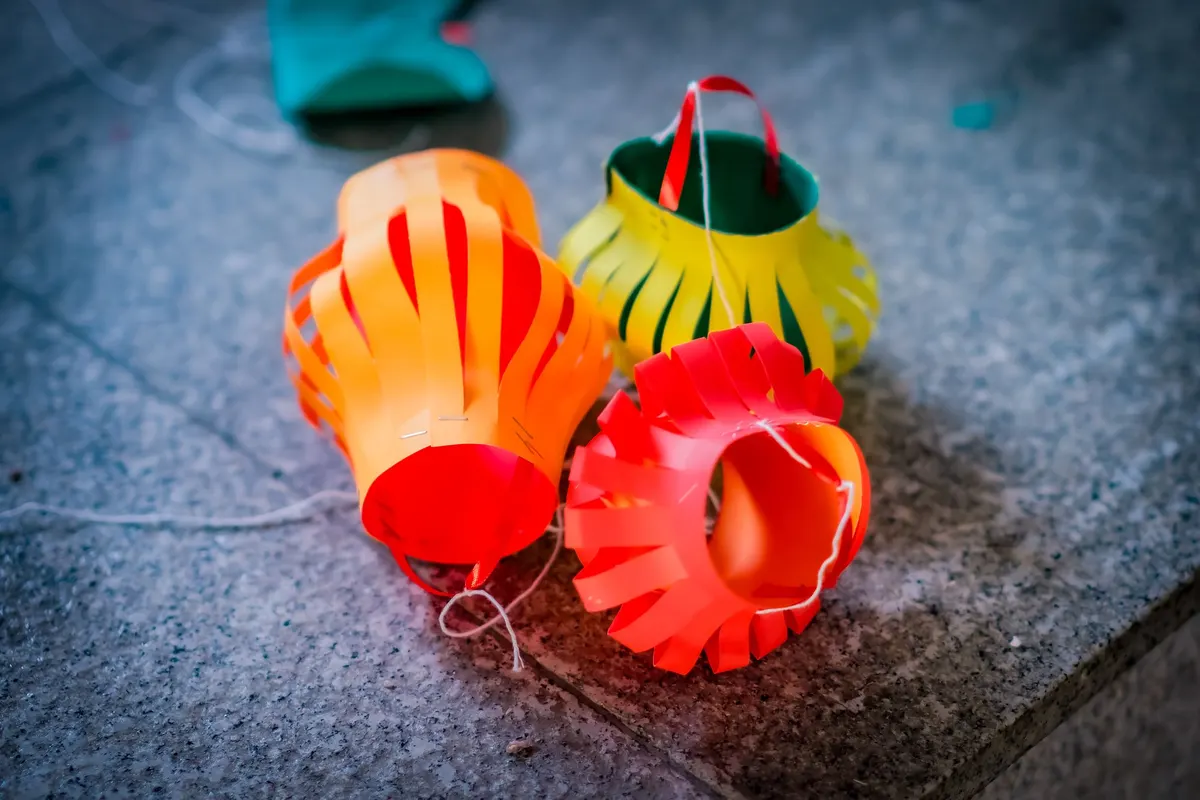
This classic school craft takes about 15 minutes per lantern. These three small cut-paper lanterns come in red, orange, yellow and green, one with a red handle. Fold an 8.5 by 11 inch sheet of construction paper in half lengthwise, cut slits from the fold every inch, stopping an inch from the edge, then unfold, roll into a tube and staple. Add a 1 by 8 inch strip for a handle. Kids aged 5 and up can do most of it with safety scissors. Hang a row of 6 to 8 along a window or bookshelf with string and painter's tape.
19. Display one goat figure for the new year
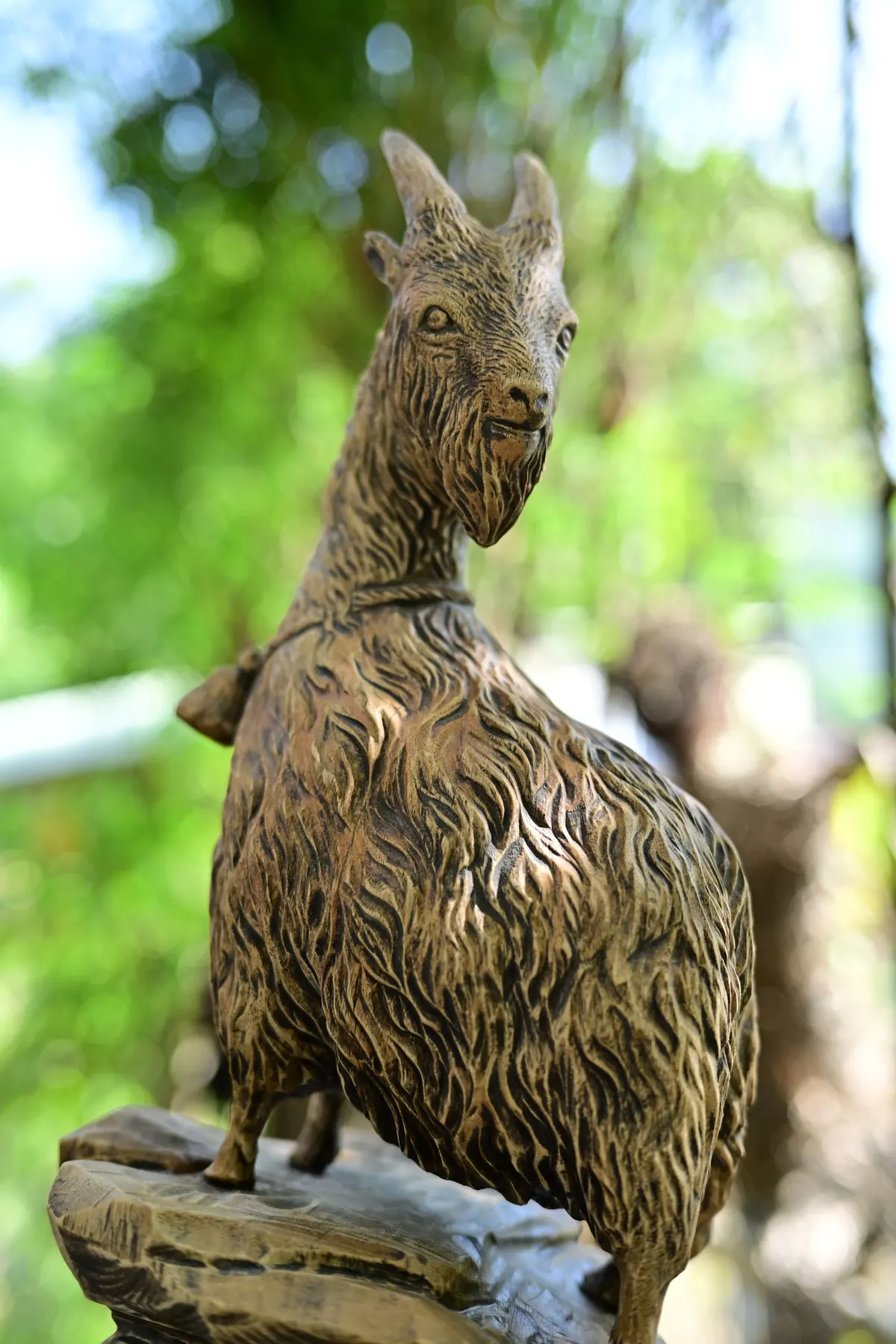
This carved brown wooden goat with curved horns and a small bell stands on a carved base. Put one 4 to 8 inch goat or sheep on the mantel, the entry table or next to the mandarins. Anyone born in a Goat year (2015, 2003, 1991, 1979 and earlier, every 12 years) may enjoy getting one as a small gift. Check birth dates, since the zodiac year starts on Lunar New Year, not January 1.
20. Save some lanterns for the Lantern Festival
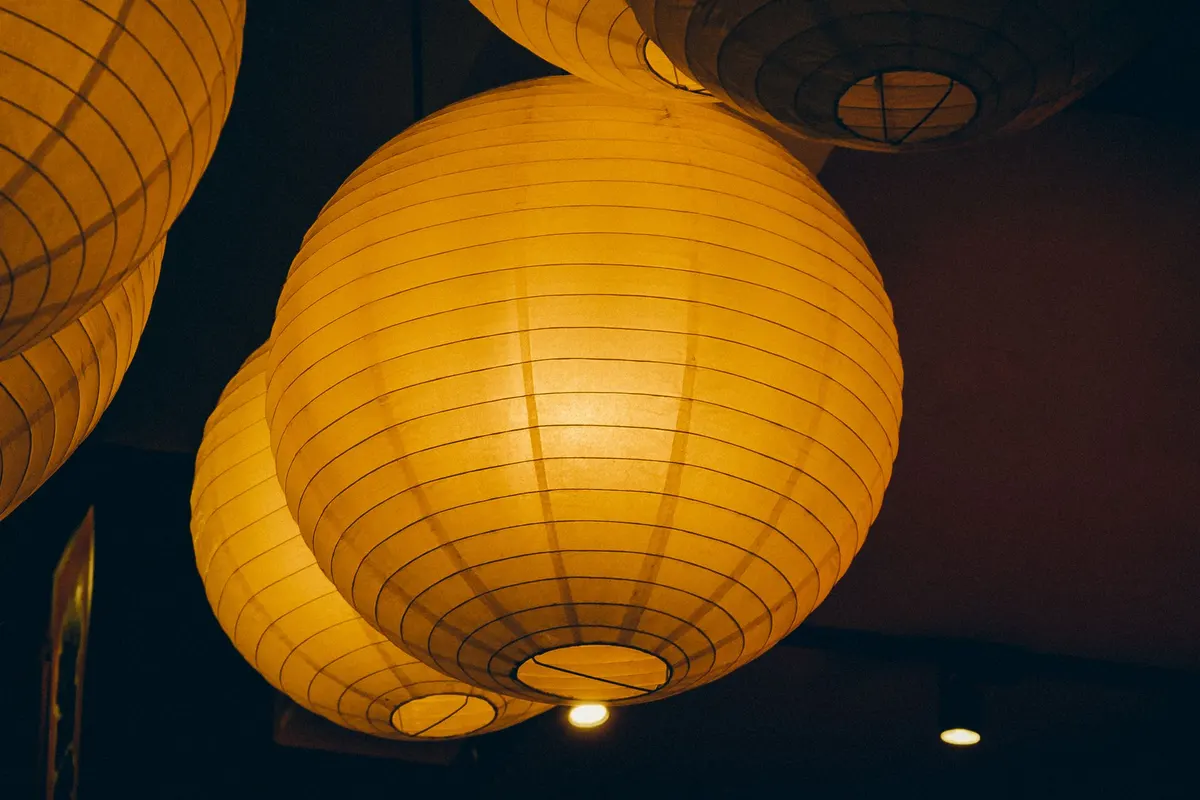
The season ends on the 15th day of the first lunar month with the Lantern Festival, which falls on February 20, 2027. Keep your decor up until then, and add one more round of light for the last night. These six yellow-orange round paper lanterns hang close together under a dark ceiling, which shows how a tight cluster glows. Hang 5 to 7 lanterns with LED lights inside over the dinner table, and serve sweet rice balls (tangyuan) if you want the food that goes with the night. Our New Year's Eve decorations cover more party lighting ideas.
Final tips
- Clean before you decorate, and ask your family which days they avoid sweeping.
- Hang couplets with the first line on the right as you face the door unless the set says otherwise.
- Use LED lights in every paper or fabric lantern, never candles.
- Buy decor at an Asian grocery store in January, when selection is best and prices are low.
- When customs differ, go with what your family or community does.
Frequently asked questions
When is Lunar New Year 2027?
Lunar New Year 2027 falls on Saturday, February 6, and starts the Year of the Goat, also translated as sheep or ram. New Year's Eve, with its reunion dinner, is Friday, February 5. The celebration traditionally runs 15 days and ends with the Lantern Festival on Saturday, February 20, 2027.
When should you put up Lunar New Year decorations?
Many families clean the house first, then hang couplets, fu signs and lanterns in the last day or two before New Year's Eve, which means February 4 or 5 in 2027. Decorations usually stay up through the Lantern Festival on February 20. Some households follow their own timing, so ask relatives.
Which side does each spring couplet go on?
Traditionally, as you face the door from outside, the first line goes on the right and the second line on the left, with the four-character horizontal scroll centered above. If the horizontal scroll is written left to right, many guides say to switch the sides. When unsure, ask the shop or an older relative.
Why is the fu character hung upside down?
In Mandarin, the word for upside down (dao) sounds like the word for arrive (dao), so an upside-down fu suggests that good fortune has arrived. Customs vary. Some families keep the fu on the main door upright and turn it upside down only on inner doors, cabinets or rice containers.
What colors should you avoid for Lunar New Year decor?
Red and gold are the usual choices because they are linked with luck and celebration. Many families avoid decorating mostly in white or black, since white is associated with mourning in Chinese tradition. Small white accents such as blossoms are common, so think of it as a guideline rather than a strict rule.
You might also like
 World holidays
Hanukkah Decorations: 20 Menorah, Table and Door Ideas
 World holidays
20 Diwali Decoration Ideas for Your Home
 World holidays
Kwanzaa Decorations: 20 Ideas for the Kinara, Table & Home
 Valentine's
Valentine's Day Decor Ideas: 21 Easy Looks for Every Room
 Halloween
22 No-Carve Pumpkin Ideas: Paint, Fabric, Tape and Stacks
 Christmas
Christmas Table Decor Ideas: 20 Linens, Runners & Centerpieces